Editorial, Press

The Ultimate Third-Party Resource for Remote Monitoring

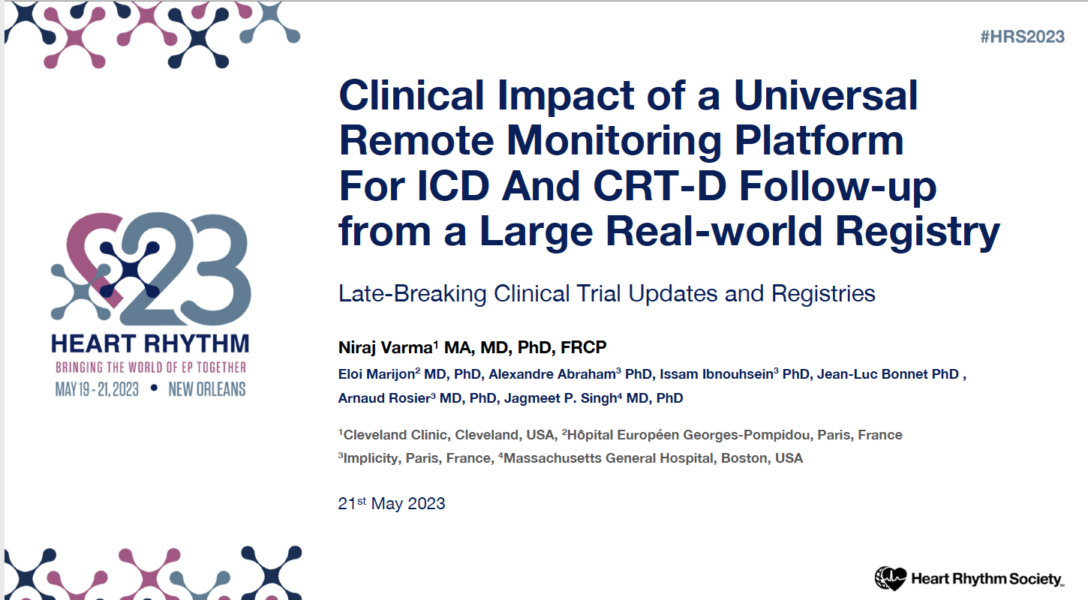
The Ultimate Third-Party Resource for Remote Monitoring Since 2015, remote monitoring has been the standard practice for managing patients with cardiovascular implantable electronic devices, leading to decreased morbidity and mortality. The significant benefits of remote monitoring have been evident over the past eight years, prompting the release of an HRS/EHRA/APHRS/LAHRS consensus statement in May 2023. This statement included updated guidelines on managing patients with cardiovascular implantable electronic devices. The comprehensive guidelines include the recommendation for organizations to consider taking their remote monitoring a step further and integrating third-party resources into their process. Imagine an alert-based, AI-driven third-party solution that meets all the demands of remote monitoring and is associated with reducing mortality by 22% and hospitalization by 4%.1 Implicity’s comprehensive solution is reshaping the landscape of remote monitoring by emerging as the ultimate platform for remote device clinics. It effectively addresses even the most difficult challenges associated with this practice. Administrative Burden and Staff Burnout:Handling administrative tasks alongside patient care can lead to burnout among clinical personnel. Implicity’s powerful remote monitoring (RM) solution automates once manual processes, allowing providers to streamline their workflow and dedicate more time to delivering exceptional patient care. With a proven track record of achieving an impressive 84% increase in clinic productivity within just two years, the unique third-party solution empowers healthcare professionals to enhance efficiency, ultimately improving staff satisfaction and the overall quality of care.2 Managing High-Volume Data:In the era of digital healthcare, the sheer volume of remote monitoring data can be overwhelming and especially challenging when resources are short. Leveraging alert-based solutions like Implicity makes managing and reviewing vast amounts of data easier. This ensures timely communication of results, empowering healthcare providers with valuable insights for optimal decision-making. The Financial Strain on Clinics:Running a remote monitoring program can be financially burdensome for clinics. Third-party solutions can offer a path to financial stability through an innovative approach. In fact, Implicity has been proven to achieve an impressive 90% billing compliance rate, ensuring that clinics can maximize their revenue potential.3 By harnessing the expertise and resources of Implicity’s third-party involvement, clinics can improve staff efficiency and reduce costs associated with administrative tasks. This strategic collaboration with Implicity brings financial advantages and paves the way for sustainable growth and success in remote monitoring programs. Communication Gaps between Providers and Patients:Effective communication lies at the core of exceptional healthcare delivery. Recognizing this, the Implicity platform streamlines data review and facilitates real-time communication of results. By bridging the gap between providers and patients, Implicity enhances care coordination, ensuring seamless communication for improved patient-provider relationships. By embracing the transformative CRM solution offered by Implicity, clinics can alleviate administrative burdens, enhance staff efficiency, streamline data management, achieve financial stability, and dedicate more time to direct patient care. It’s time to unlock the full potential of remote monitoring and revolutionize care like never before. By: Megan Grosz 1Varma N, Marijon E, Abraham A, Ibnouhsein I, Bonnet J-L, Rosier A, Singh Heart Rhythm Journal, LB-456088-2, in press, May 16, 2023 The original abstract results can be found here. Differences in results with HRS presentation are due to methodological improvements.2Implicity data. Staff productivity increased after two years of using the Implicity platform, based on data from 56 medical centers3Jay Ganji, MD, FACC, Cardiologist, Piedmont Cardiovascular, November 2022.
Contributed Article, Press

How RPM Can Reduce AI’s Bias Problem and Improve Health Equity

How RPM Can Reduce AI’s Bias Problem and Improve Health Equity Artificial intelligence (AI) is one of the most promising breakthrough technologies of the modern healthcare era, yet it also has the potential to be one of the most dangerous.  AI algorithms trained on limited or poorly representative data sets can exhibit signs of bias in their results, skewing decision-making and possibly leading to ethnic, gender, and social discrimination and other unintentional consequences for the patients they serve. Unfortunately, research shows that bias is already creeping into the nascent field of AI and machine learning.  In 2019, one study found that a widely used algorithm was underrepresenting the illness burden of black patients compared to white patients, meaning that Black individuals had to be much sicker to get a recommendation for the same level of care as their white counterparts. It was also well documented that in many cases, Watson, IBM medical AI was affected by bias, recommending therapies not accessible to the population using the software. Concerns over bias create distrust in AI and often keep healthcare leaders from fully embracing the technology. It is imperative that we address the rising risks of AI bias before the ecosystem becomes even more established. We must find better ways of connecting with more diverse and representative patients to ensure trust by ensuring algorithms are trained with large and diverse datasets. Remote patient monitoring (RPM) can be one key to achieving this goal. By reaching more patients in different geographies and reducing barriers to patient access, RPM can help build trust in AI and improve health equity by broadening the diversity of datasets used to train AI algorithms. Progress is already being made in remote cardiac monitoring.Unbiased Prediction of Heart Failure The first step to reducing bias in AI tools is to increase the diversity and representation of data. Given the growing use of cardiac remote monitoring, an increasing volume of patient data is being gathered from connected devices. Moreover, in 2019, as part of its national strategy on AI, the French government created the Health Data Hub. The platform combines all nationwide sources of data, including all resource utilization such as hospitalization and follow-up, but also medications and causes of death. Since France is a centralized single-payer system, this data is gathered from across the country. The database was made available to selected organizations, but Implicity was the only cardiac remote monitoring platform to gain access. to Implicity is now using the nationwide database to develop research and algorithms with better performance and less bias. The Health Data Hub provides access to anonymized patient health information from more than 3.7M people. Implicity has combined this data with data collected from remote cardiac monitoring devices, creating a unique dataset that is the foundation for developing an innovative algorithm that can reliably predict acute heart failure episodes in patients with cardiac implant monitoring.  Because of the robust data sets, this algorithm can potentially eliminate or drastically reduce bias and improve health equity. Benefits Beyond the Algorithm Aside from eliminating bias in AI, RPM is also changing how clinical research is performed by broadening patient access to studies. For example, equipping cardiac patients with RPM devices in their homes can reduce the necessity to come into the clinic for routine checks for things like blood pressure, weight, cardiac rhythms, or blood sugar.  This could make participation in research more viable and attractive for more diverse patient groups, including those with limited access to centralized trial sites. Today, research is often conducted in urban areas at large academic medical centers (AMC), which can be hard to reach for rural populations and those facing other transportation barriers. Trials demand regular attendance at frequent appointments, which can be problematic forpeople who cannot afford time off work, the expenses of childcare, or the risks of leaving otherfamily members at home without a caregiver. As a result, only the patients who have adequate time, money, and social support can participate in research or contribute their data to AI tools and similar projects. These patients tend to be less likely to have significant burdens of chronic disease, are more likely to havehigher health literacy rates – and due to the nature of systemic oppression in the United States, are more likely to be white than members of other racial and ethnic groups. We know the same therapy can act differently in people of diverse genetic backgrounds. And we know that socioeconomic burdens can significantly affect a patient’s ability to access and adhere to recommended care. But we are not doing enough to extend the healthcaresystem to places where underserved populations live, work, and play. By digitizing home health-related data from the source, RPM contributes to less selection bias in research.Creating a  More Equitable Future RPM also offers the advantage of continuous data collection in many cases, giving researchers a much richer and more accurate picture of a person’s health unaffected by  “white coat syndrome,” which can alter certain readings.  Real-world data that is collected as part of everyday life is extremely valuable for identifying the efficacy and safety of new therapies and devices. Developing a strong feedback loop between RPM and AI to support continuous improvement is especially important since many RPM devices rely on AI algorithms to perform their basic functions to begin with.  Ensuring that developers are learning from the experiences of actual patients using their devices outside of tightly controlled research settings can help to identify hidden biases and course-correct them before any issues arise. As AI becomes more sophisticated, we must invest in patient recruitment strategies and data governance guardrails that prioritize equity and take advantage of RPM and other technologies to reduce barriers to accessing representative data. Studies and algorithm development projects should include perspectives from diverse points of view in the design phase, including clinicians and patient participants with varying backgrounds.  Institutions sponsoring research projects, or companies developing algorithms, should establish minimums for diversity and inclusion in their training data sets to ensure

Press, Press Release

Implicity Study Presented in Late-Breaking Clinical Trial Session at Heart Rhythm 2023

Implicity Study Presented in Late-Breaking Clinical Trial Session at Heart Rhythm 2023 Cambridge, Mass., May 22, 2023 – Implicity, a leader in remote patient monitoring and cardiac data management solutions, announced the findings of a study presented during a late-breaking clinical trial session at the Heart Rhythm Society’s (HRS) annual meeting. The research was conducted in collaboration with the French government’s Health Data Hub, using a nationwide database of health information from more than 68,000 patients. Implicity linked real-world data from patients with cardiac implantable electronic devices (CIEDs) to various remote monitoring (RM) methods, comparing differences in mortality rates, number of annual hospitalizations per patient, and cumulative duration of hospital stays in a year. The results showed significant disparities in mortality rates based on the method of RM utilized. While all patients with RM experienced improved survival rates, Implicity’s universal, alert-based remote monitoring platform was associated with a greater performance compared to historical manufacturers’ solutions (Abbott, Boston Scientific, Medtronic). Notably, patients monitored with Implicity’s platform experienced a remarkable 22% relative improvement in all-cause mortality when compared with conventional RM methods, even after adjusting for confounding factors such as age, gender, CIED type, year of implant and center size. Additionally, the study revealed a significant reduction in both the number of annual hospitalizations per patient (-4%) and cumulative duration of hospital stay within a year (-6%), further validating that alert-based systems like Implicity’s can lead to superior patient outcomes in cardiac care. “We already know that remote patient monitoring saves lives. What data from this study shows is that clinical improvements vary a lot depending on how remote monitoring is performed. We saw significant improvement in mortality rates but also a decrease in hospitalizations when clinicians were supported by the Implicity platform rather than device manufacturer systems alone. This shows that the most committed teams with the best tools have the potential to achieve a better outcome for these patients. What’s remarkable is that these results occurred even before we launched our unique AI algorithms, so we can hope for even better results down the road.” said Implicity CEO and co-founder, Arnaud Rosier, MD, PhD. For more information, visit: www.implicity.com About Implicity Implicity is a digital MedTech software company dedicated to providing the best remote care to patients with connected cardiac implantable electronic devices. Co-founded by cardiac electrophysiologist Arnaud Rosier, MD, PhD, our platform aggregates, normalizes, and standardizes data from any implantable cardiac device across all manufacturers, improving care for patients with cardiac implants and heart failure. Implicity’s platform provides critical health information augmented by FDA-cleared AI algorithms, enabling healthcare providers to make more informed decisions for better patient outcomes. With access to the Health Data Hub*, one of the world’s largest databases of heart disease patients, Implicity is able to develop its AI solutions based on more robust data. The company is protecting more than 80,000 patients in over 150 medical facilities across the US and Europe. To learn more, visit www.implicity.com * Health Data Hub is a health data platform established by the French government to combine existing health patient databases and facilitate their usage for research and development purposes. Original abstract results can be found here. Differences in results are due to methodological adjustments.

Press

Implicity US Receives Thumbs Up from Users in 2022

Implicity US Receives Thumbs Up from Users in 2022 Improving population health by harnessing the power of digital data fuels the innovative spirit at Implicity. Our effort is supported by the – feedback from the health providers we serve.One way we receive feedback and assess user satisfaction is through a net promotor survey by which customers rate their user experience. The result of these surveys is a net promotor score or NPS. Scores are based on a set of questions that seek to find the likelihood that respondents will recommend a product, service, or company to someone else. Implicity US is proud to share that – the company earned an overall net promoter score of 63 in 2022. The universal NPS scale ranges from -100 to 100+, placing Implicity at the top end of the scale. ¹ User satisfaction should not be viewed as the destination but as a daily goal that must be met with greatness to deliver the best in patient care. At Implicity, we embrace that goal every day. ¹ https://customer.guru/net-promoter-score

Press, Press Release

The Association of German Cardiologists BNK Lists the Telemonitoring System Offered by Implicity and HCSG

The Association of German Cardiologists BNK Lists the Telemonitoring System Offered by Implicity and HCSG The Association of German Cardiologists BNK Service GmbH lists the telemonitoring system “hedy” from HCSG and IMPLICITY to cardiologists in private practice. As a unique cloud-based and vendor-independent platform for heart failure telemonitoring, hedy enables telemonitoring with external devices and implants from all major manufacturers via a common TMZ portal. This listing by BNK Service GmbH was made after intensive testing and based on positive references from cardiologists who are already using the hedy telemonitoring system today. Since the beginning of 2022, telemonitoring patients with heart failure (cardiac insufficiency) has been part of the outpatient service offered by the statutory health insurance funds. “We want telemonitoring for heart failure to reach all patients eligible for this innovative treatment method as quickly as possible. That is why we are pleased to have gained HCSG and IMPLICITY, two very capable partners for cardiology practices.”Susanne Oldenburg of BNK Service GmbH. To implement telemonitoring, a cardiology-led telemedicine center (TMZ) must use either external devices (scales, ECG and blood pressure monitors, and patient apps) or data from implants (special pacemakers and defibrillators). For this purpose, hedy offers a unique cloud-based platform for telemonitoring of heart failure, via which the data of implants from all major manufacturers and external devices can be displayed and evaluated automatically and independently of the manufacturer via a common TMZ portal. Hedy requires no IT installation or maintenance of IT systems in the physicianˈs office. Physicians can access HCSGˈs certified tele-nurse center, relieving their practices of routine tasks. “Cardiologists need the support of competent service providers to operate a telemedicine center. The practices we interviewed reported their excellent experience, reliable service, and HCSGˈs profound expertise in monitoring with external devices. Implants from all major manufacturers can be connected via the IMPLICITY system. This provides cardiologists with a common portal for all forms of telemonitoring. We see this as a great advantage for patient care.”Simon Glück, Managing Director of BNK Service GmbH. BNK Service GmbH has intensively tested the technology and service offering around hedy. The consistently positive feedback from practices that operate a TMZ with hedy and have already gained sound experience in its use has convinced BNK Service GmbH. To date, around 350 physicians are using hedy telemonitoring. Users of hedy can be found in individual practices as well as in sizeable professional practice groups (joint practices) or medical care centers (MVZ). “We want to ensure that all heart failure patients receive optimal care. Even those who find it difficult to get to the doctor because they live in rural areas or, in particular, the elderly patients. With hedy and the companies HCSG and IMPLICITY at our side, the start for this is quite easy, and we canbenefit from their years of experience. The direct accessibility and service canˈt be beaten.”Dr. Placke specialist practice for cardiological primary and specialty care in Rostock, Germany. “We had already preferred the hedy telemonitoring system based on recommendations from colleagues. The presentation of experienced users of the hedy solution for external devices and implants in the BNK webinars strengthened our decision. And we are starting with hedy in the new year.”Dr. med. Gabelmann and Prof. Pottgießer, Cardiology Dreisamtal/Kirchzarten Background:Since the beginning of 2022, telemonitoring patients with heart failure (cardiac insufficiency) has been part of the outpatient service offered by the statutory health insurance funds. Telemonitoring can be prescribed to patients with heart failure (NYHA II – III and EF < 40) if they have been treated in the hospital in the last 12 months or if they wear a suitable implant.To implement telemonitoring, a telemedicine center (TMZ) must use either external devices (scales, ECG and blood pressure monitors, and patient apps) or implants (special pacemakers and defibrillators). Hedy (https://hedy.de) refers to a system for telemedicine care of patients with heart failure. The solution is aimed at cardiologists who want to operate their own TMZ. Hedy is a registered trademark of Health Care Systems GmbH. Cooperation partners:HCSG specializes in telemonitoring with external devices, while IMPLICITY processes the data of implants from all major manufacturers for cardiologists. With the complete solution from HCSG and IMPLICITY, consisting of devices, software, service, and consulting, cardiologists can immediately set up their own TMZ (https://www.IMPLICITY.com/landing-page/partnership-IMPLICITY-x-hcsg/). BNK Service GmbH (https://www.bnk-service.de/) is the subsidiary of the Bundesverband Niedergelassener Kardiologen (BNK) e.V., which represents more than 90 percent of the practicing cardiologists in Germany. BNK Service supports approximately 1,200 cardiologists in their daily practice. In addition, as a specialized service provider for the entire cardiology field, it networks all the players involved in care. As a central interface, BNK Service GmbH develops and manages comprehensive care concepts, conducts scientific surveys on care research, and thus provides a realistic picture of cardiological care in Germany.Your contact: Simon GlückPhone: +49 89 41 42 40 8-14, Email: simon.glueck@bnk-service.de IMPLICITY (https://patients-info.implicity.com) is a digital medical technology company that provides healthcare providers with a universal telemonitoring platform that aggregates and uniformly displays implantable cardiac implant data from all major manufacturers. In addition, IMPLICITY develops AI and knowledge-based algorithms to empower physicians and enable them to predict patient health status. IMPLICITY serves over 80,000 patients in more than 150 medical facilities in Europe and the US.Your contact: Karsten HagemannPhone: +33 680 10 50 65, Email: karsten.hagemann@patients-info.implicity.com Health Care Systems GmbH (https://hcsg.de) is a leading provider of solutions for digital precision medicine. The HCSG team has more than 16 years of experience in telemedicine care for patients with heart failure. Today, HCSG serves patients throughout Germany and Switzerland with more than 60 employees at three locations. HCSG has developed the hedy Telemonitoring Program (https://hedy.de) specifically for use in telemedicine centers. The system is particularly easy to use because it is tailored to the needs of older people with severe chronic illnesses. Specialized nurses staff HCSG’s service center with special training in telephone care for people with heart failure. Health data is processed in a high-security data center in Germany.Your contact: Christian KlossPhone: +49 89

Editorial, Press

Remote Monitoring Device Clinics- Managing Through the Chaos

Remote Monitoring Device Clinics- Managing Through the Chaos Those who have dedicated their lives to cardiology are experiencing burnout at a record pace. This is especially true for physicians and medical teams remotely monitoring patients with CIEDs (Cardiac Implantable Electronic Devices). The growing number of patients involved in remote monitoring (RM) programs has led to increased data that cardiac clinics need to review and manage. The issue will only get worse in the coming years. According to the results of a 2019 study led by Divyang Patel, MD, Cleveland Clinic, some 300,000 patients a year are receiving new CIED implants – making RM even more complex and challenging for clinicians. In her 2022 study, Challenges in managing a remote monitoring device, Margaret Harvey, Ph.D., ACNP-BC, uncovered major themes plaguing the efficiency of RM in the cardiac clinic, such as poor connectivity, staffing issues, and a large volume of false positive alerts.Medical staff is drowning in an onslaught of data that cripples staff productivity and efficiency. But with every challenge comes opportunity. Dr. Harvey says the industry must adapt and develop innovative solutions that move healthcare forward. Luckily, digital health solutions already exist that can help ease the burden of RM data processing. Implicity offers a fully integrated SaaS solution that automates remote workflows, easing the burden on already overworked clinical staff. For example, the Implicity platform recently received FDA approval on an exclusive AI algorithm that automatically reduces the number of ILR false positives by 79% *. False positives from ILRs aren’t mere annoyances; they burden medical teams with so much extra work that it can effectively reduce the number of patients a clinic can support. Using an AI algorithm to reduce the “noise” of ILR alerts reduces the time clinicians and staff must dedicate to taxing data analysis. Also worth mentioning is Implicity’s disconnected patient feature. The platform auto-notifies the patients’ medical team when they become disconnected from the manufacturer’s website. A series of automated SMS messages are exchanged between the platform and the patient to obtain and record the reason for the disconnection, all without involvement from the clinical staff. Managing this process automatically ensures patient records are always up to date, have greater billing accuracy, and have higher staff productivity. There are many choices regarding remote monitoring software, but they are not all created equal. Clinics should look for a partner that easily integrates with their EHR and all the device manufacturer websites to streamline their process. Keeping future growth in mind, look for AI platforms to ensure continued access to relevant, robust data. By:Megan Grosz Download PDF

Contributed Article, Press

What’s in Store for Biotech in 2023?

What’s in Store for Biotech in 2023? Electrophysiologist Arnaud Rosier, CEO, and Co-Founder at Implicity, sits down with LABIOTECH to discuss AI’s expanding role in Cardiology “In 2023, we will see the first large-scale use of AI algorithms in healthcare. Several factors, including the speed of innovation, are driving this surge. AI algorithms are improving, making models more accurate and reliable. More and more healthcare organizations will start utilizing artificial intelligence across clinical and non-clinical domains. “Another force driving AI adoption is the clinician burnout epidemic. Covid-19 stretched an already thin healthcare staff nearly to their breaking point, and the “Great Resignation” that followed has made it difficult for clinics and hospitals to find and retain talent. Technology, specifically artificial intelligence, may become a viable solution for many providers to help reduce workloads and alleviate stress by eliminating routine, mundane tasks.” Visit LABIOTECH for the full article

Contributed Article, Press

AI for Electrophysiology: Cutting through the noise

AI for Electrophysiology: Cutting through the noise The use of AI in electrophysiology is increasing; it’s being applied to personalize treatment to achieve better outcomes, to manage patients more effectively, and it’s relieving the burdensome workflow of a data-intensive clinical practice. Electrophysiology is among the most data-driven of medical specialties, perhaps because these cardiac physicians chronically deal with the risk of imminent death. On the intervention side, when performing cardiac ablations, they work with highly technical patterns of electrical signals in real-time to figure out the source of problems so they can fix them. When it comes to patient management, they face an ever-increasing burden of daily downloads of data from cardiac implantable electronic devices (CIEDs), including pacemakers, ICDs (implantable cardioverter defibrillators), cardiac rhythm therapies, and implantable loop recorders (ILRs). In the US, where cardiac arrhythmias impact about 14.4 million patients, CIEDs have become the prevalent treatment choice. More than 300,00 people are implanted with cardiac monitoring devices every year, and this number is likely to increase because of the increasing prevalence of atrial fibrillation. Visit MedTech Strategist for the full articleBy Arnaud Rosier, CEO of ImplicityOriginally published by MedTech Strategist

Press

HCSG and IMPLICITY® Offer German Cardiologists a Complete Solution for Remote Monitoring

HCSG and IMPLICITY® Offer German Cardiologists a Complete Solution for Remote Monitoring The two companies offer a complete solution for German telemedicine centers, including equipping patients with the devices and a TMZ portal for heart failure remote monitoring with external sensors and implants. Munich and Paris, May 20th, 2022 — HCSG and IMPLICITY, two leading providers of remote monitoring solutions in the field of cardiology, announced today the conclusion of a cooperation agreement. The two companies’ offer is aimed at German cardiologists who want to operate their own telemedicine center (TMZ). Remote monitoring of patients with cardiac insufficiency (heart failure) has recently become part of the outpatient services offered by the statutory health insurance funds. Remote monitoring can be prescribed topatients with heart failure if they have been hospitalized in the last 12 months or are wearing a suitable implant. To implement remote monitoring, a TMZ must use either external devices (scales, ECG, blood pressure monitors and patient app) or implants (dedicated pacemakers and defibrillators). HCSG specializes in remote monitoring with external devices, while IMPLICITY processes implant data from all major manufacturers for cardiologists. With the complete solution from HCSG and IMPLICITY, consisting of devices, software, service and consulting, cardiologists can immediately set up their own TMZ. The system has already proven itself in practice: « In our TMZ, we use both implants and external sensors for remote monitoring. All data is clearly displayed in a TMZ portal. This enables limit value analyses with the least possible effort, » says Dr. Ali Halboos from the GiG Telemedicine Center, Germany. The Gesellschaft für integrierte Gesundheitsversorgung (GiG) operates 17 cardiological practices whose locations are mainly in NRW and southern Germany. « Seeing the most important information from all manufacturers automatically and at a glance allows me to provide my patients with very efficient and optimal care in remote monitoring. The user-friendly implementation of the cloud-based platform is a concrete example of IMPLICITY’s many years of experience. One example: the automatic notification of patients for whom transmissions have failed makes our day-to-day work much easier », says Dr. Lutz Sinn from the practice for cardiovascular medicine in Bad Säckingen, Germany. « I don’t want to worry about the issue of equipment, and I don’t want to have anything to do with it if there is a malfunction of the equipment or a problem with the data transmission. But I just want to know exactly when the patient is getting worse. That’s where we benefit from HCSG, which has already provided such services », says Prof. Dr. Martin Bergmann from the Cardiologicum Hamburg. With over 60,000 treatment cases per year, the Cardiologicum Hamburg is one of the largest outpatient care centers for cardiovascular medicine in Germany. ————————— About IMPLICITY® IMPLICITY is a digital medical technology company that provides healthcare providers with a universal remote monitoring platform that aggregates data from implantable cardiac implants from all major manufacturers and presents it in a uniform manner. IMPLICITY is also developing AI and knowledge-based algorithms to reduce the burden on physicians and enable them to predict the health status of patients. IMPLICITY serves more than 60,000 patients in 100 medical facilities in Europe and the US. Contact: Karsten HagemannTel: +33 680 105065 | Email: karsten.hagemann@patients-info.implicity.com   About HCSG Health Care Systems GmbH is a leading provider of digital precision medicine solutions. The HCSG team has more than 15 years of experience in providing telemedical care to over 70,000 patients with heart failure. Today, HCSG serves patients throughout Germany and Switzerland with over 60 employees at three locations. HCSG has developed the hedy Telemonitoring Program specifically for use in telemedicine centers. Contact:Dr. med. Christian KlossTel: 089 444 889 102 | Email: info@hcsg.de